Fragrance Sample Vials: From Discovery to 10ml 2026
You buy a few fragrance samples with good intentions. One lands in your desk drawer, another in a dopp kit, another in the side pocket of a weekender bag. A month later, you've got a small collection of tiny glass vials with half-remembered names, loose caps, and just enough scent left to make the decision feel unfinished.
That's a very normal place to be.
Fragrance sample vials are often the first step in finding a scent you actually want to wear. They let you test fragrance on skin, live with it for a few days, and figure out whether it feels right in real life, not just on paper in a store. But they also come with familiar frustrations. Some are dabbers. Some are sprays. Some feel useful for discovery but awkward for everyday carry.
If you're trying to make sense of that little pile of samples, this guide will help. We'll look at what fragrance sample vials are, why they matter, where they fall short, and when it makes sense to move from a tiny tester to a more polished 10ml format for travel, gifting, and daily use.
The All-Too-Familiar Drawer of Half-Used Samples
A lot of fragrance lovers start the same way. You try one scent at a counter, order a discovery set, get a few extras with a purchase, and suddenly you're keeping tiny vials everywhere because you don't want to lose them. It feels smart at first. Sampling is part of buying well, and it's often the difference between a scent that seemed perfect for five minutes and one you enjoy wearing.
Then real life gets involved.
The label rubs off. The dabber leaves more fragrance on your fingers than your neck. You can't remember whether that woody one smelled better in cool weather or whether it just caught you on a good day. And if you're heading out for a weekend, those small vials don't always feel like something you want rolling around beside your watch, charger, and passport.
Why the sample drawer keeps growing
Individuals don't collect samples because they're disorganized. They collect them because sampling is the most sensible way to explore fragrance. You want to test how a scent opens, how it changes after a few hours, and whether it still feels like you after several wears.
That's why a guide like try before you buy perfume resonates with so many shoppers. It mirrors the way people already buy fragrance now. They test first, compare, and only then decide whether something deserves more space in their routine.
Small samples are often where taste becomes clearer. You stop asking, “Is this popular?” and start asking, “Do I want to wear this again tomorrow?”
Where discovery starts to feel incomplete
The issue isn't that sample vials are bad. It's that they solve one problem very well and leave another unsolved. They help you discover a scent. They don't always help you live with it elegantly.
That's the tension behind the crowded drawer. You're not done with the fragrance. You're just done with the format.
What Are Fragrance Sample Vials
Fragrance sample vials are very small containers used to let people test a scent before buying a larger bottle. In fragrance retail, they've been around for a long time and usually come in small capacities such as 1.5 ml, 2 ml, or 2.6 ml, according to SGD Pharma's perfume sample vial range. The same source lists a 1.5 ml vial at 40 mm high, 10.25 mm in diameter, and 1.9 g in weight, which helps explain why this format works so well for discovery sets, mailings, and gifting.

The main types you'll see
Not every small fragrance container works the same way. That's where a lot of confusion starts.
Dabber vials
These are the tiny glass vials with a stopper cap. You open them and apply the fragrance by touching the stopper or vial opening to skin. They're common because they're simple, compact, and widely used in sampling.
Spray vials
These have a miniature atomizer, so you spray the fragrance instead of dabbing it on. They usually feel more familiar because they mimic the way most full bottles are worn.
Mini bottles and discovery sets
Some brands use small replica bottles or bundled sample assortments. These are less about one scent and more about comparing several fragrances side by side.
Why glass is so common
Good sample vials are often made from Type 3 glass or similar pharmaceutical-grade glass, valued for chemical resistance, thermal stability, and clarity, as described by Berlin Packaging's clear glass perfume sampler vial product page. In plain terms, that means the container is chosen to help protect the fragrance and present it cleanly.
That packaging choice also explains why labels matter more than people think. On a very small vial, the finish and readability of the label can affect both the practical experience and the visual impression. If you're curious about the design side, this guide to choosing product label materials and finishes gives a useful overview of how texture, durability, and print choices shape small-format packaging.
Practical rule: If a fragrance sample feels confusing to use, check the closure first. The biggest difference in experience often comes down to whether it's a dabber or a spray.
Why this format became standard
The reason is simple. A small vial gives a person enough fragrance to test it more than once, while staying compact and easy to ship. It's familiar to shoppers, practical for brands, and low-commitment for anyone who doesn't want to buy a full bottle too soon.
That's why fragrance sample vials remain such a central part of how people discover scent.
The Pros and Cons of Traditional Vials
Traditional sample vials still do an important job. They lower the pressure around fragrance buying and make experimentation feel manageable. That matters because fragrance is personal. A scent can smell elegant on paper, then feel too sharp, too sweet, or not like you once you wear it through the day.
A 2025 survey of 1,247 European consumers cited by Scento found that 67% of buyers regret at least one fragrance purchase, and that sampling reduced buyer regret by 86%. The same source says fragrance ownership shifted from about 2.5 bottles before 2020 to 6–10 bottles on average by 2026, reflecting a move toward a fragrance wardrobe rather than a single signature scent, according to Scento's fragrance consumer behavior statistics.

What traditional vials do well
They're good at one phase of the fragrance journey. Discovery.
- Low-commitment testing lets you wear a scent before deciding whether it deserves a larger bottle.
- Easy comparison makes it simpler to test several styles across different days, outfits, or occasions.
- Portable size means you can slip one into a bag or pocket without much effort.
- Scent wardrobe building becomes more realistic when you can explore multiple directions instead of forcing one fragrance to do everything.
For anyone learning their taste, that's useful. You might discover that you enjoy iris more than citrus, or that a smoky evening scent doesn't suit your weekday routine.
Where the experience starts to break down
The weakness of the traditional vial is usability. The format is built for trying, not necessarily for carrying and wearing gracefully.
Some of the most common frustrations are easy to recognize:
- Dabber mess leaves fragrance on fingers and can make application feel imprecise.
- Very limited volume means the test may end before you've fully made up your mind.
- Fragility makes tiny glass containers less reassuring in a packed travel bag.
- Lack of polish means a sample rarely feels gift-worthy on its own.
A sample vial is often enough to tell you whether you like a fragrance. It isn't always enough to make that fragrance part of your routine.
A good format with a narrow job
That's the fairest way to think about it. Traditional vials are not a failed product. They're a specialized one.
They help answer the first question: “Do I like this scent?”
They don't fully answer the next questions: “Do I want to carry it?” “Can I reapply easily?” “Would I be proud to give this to someone?”
Those questions matter more once fragrance moves from testing into daily life.
How to Use and Store Sample Vials Correctly
A small vial can give you a much better read on a fragrance if you use it carefully. Most mistakes happen because people rush the test, apply too much from a dabber, or leave the vial somewhere warm and bright between wears.
That matters because fragrance sample vials are designed with small internal headspace and tight-sealing closures to reduce evaporative loss and contamination risk, as described on Discount Vials' sampler vial specification page. In simple terms, they're built to protect the scent for short-term use, but storage still matters.
How to apply a dabber without wasting fragrance
If your sample doesn't spray, don't tip it all over your wrist. Use a lighter hand.
- Open it carefully so you don't flick fragrance onto your clothes or desk.
- Touch, don't soak. Place a small amount on pulse points such as the wrists or neck.
- Test it in context. Wear it on a workday, on an evening out, or during a commute. Fragrance often feels different in motion than it does at home.
- Don't judge in the first minute. Let it develop before deciding whether it's a yes or no.
How to store small vials well
Storage doesn't need to be complicated. It just needs to be consistent.
- Keep them away from heat so the fragrance stays closer to its original character.
- Avoid direct sunlight because light exposure can work against delicate formulas.
- Close the cap firmly after every use to reduce leakage and evaporation.
- Store them upright when possible if you're keeping several together in a tray, drawer, or pouch.
If you travel often, a dedicated case helps keep tiny bottles from getting lost or knocked around. A practical guide to a perfume travel case can help if your samples tend to disappear into the bottom of a larger bag.
Keep samples where you'd keep good skincare. Cool, dry, shaded, and easy to find.
A simple testing habit that works
Try one fragrance at a time for a few days instead of opening five at once. Write down a few words after each wear. Not formal notes. Just honest reactions like “clean for work,” “too sweet after lunch,” or “great on a cold evening.”
That small habit turns a pile of vials into useful decisions.
Upgrading Your Experience with a Travel Atomizer
The move from a sample vial to a travel atomizer isn't just about getting more fragrance. It's about changing the way you wear it.

Many people like the idea of samples but dislike the reality of using them once they're out in the world. That gap is real. Independent fragrance commentary and retail descriptions point to a clear split between 1 ml dabber vials and sprayable travel formats, with the former often treated as the default sample and the latter as a separate, more usable option, as discussed on Air & Weather's perfume samples page.
Why the spray format changes everything
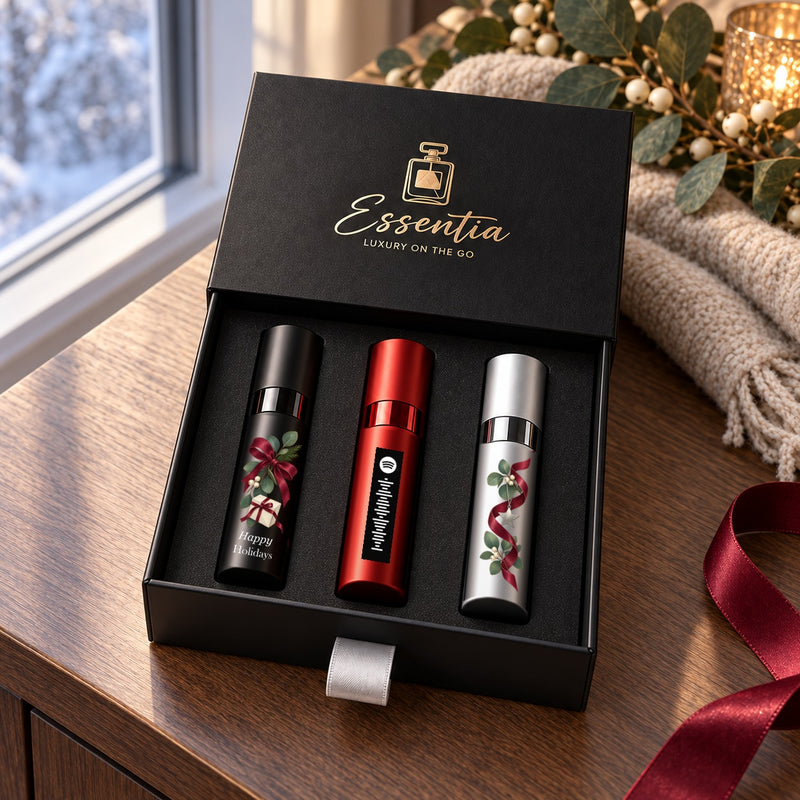
A travel atomizer applies fragrance in a way that feels closer to the full-bottle experience. You get a finer, more even mist. Reapplication is quicker. Your hands stay clean. The whole interaction feels more intentional.
That makes a difference in ordinary moments:
- before a meeting
- after the gym
- on a weekend trip
- before dinner
- in the car before an event
A tiny dabber can technically come along for those moments. A spray atomizer is usually the format people prefer to use.
Sample vial vs 10ml travel atomizer
| Feature | Fragrance Sample Vial (1.5-2ml) | Essentia Travel Atomizer (10ml) |
|---|---|---|
| Use case | First testing and short comparison | Ongoing wear, travel, gifting, and daily carry |
| Volume | Small amount for a limited test period | Larger carry-ready format for repeated use |
| Application method | Often dabber, sometimes spray | Spray atomizer |
| Convenience | Good for trial, less polished for reapplying on the go | Easy to use throughout the day |
| Durability | Small and light, but can feel delicate | More substantial everyday format |
| Gift-worthiness | Usually functional rather than presentable | Better suited to a thoughtful gift experience |
The difference in real life
At this point, the conversation usually becomes less technical and more personal. A sample vial asks you to tolerate a little inconvenience because the point is discovery. A travel atomizer assumes you've moved past that stage and want a format that fits your routine.
If you're comparing small formats more broadly, this guide to small cologne bottles is useful because it helps separate true samples from carry-ready bottles.
For a quick visual sense of how portable fragrance formats fit into daily use, this short video gives helpful context.
Wearability matters. If a fragrance is good enough to keep, it's worth putting in a format that makes you want to reach for it.
When to make the upgrade
You don't need to upgrade every sample. But a travel atomizer makes sense when a fragrance has already proven itself. You've worn it enough to know it suits your life, and now you want a bottle that can stay in your bag, on your desk, or in your travel kit without feeling temporary.
That's the point where fragrance stops being a test and starts becoming part of your day.
A Guide to Gifting Travel and Buying Fragrance
A fragrance sample is useful. A travel-size bottle feels considered.
That difference matters most in three situations: when you're buying a gift, packing for travel, or trying to buy fragrance more thoughtfully. A small sample says, “try this.” A well-made 10ml bottle says, “I chose this with a purpose.”

Why 10ml works so well as a gift
A gift should feel complete when someone opens it. That's where many traditional sample formats fall short. They're helpful for testing, but they rarely feel substantial on their own.
A 1.5 ml sample is good for approximately 3–5 wears, according to Surrender to Chance's sample guidance. That's useful for real-world testing. It also helps explain why a 10ml format occupies a different role. It bridges the space between discovery and ownership, which makes it especially well suited to gifting, travel, and everyday carry.
What to look for when buying fragrance in a small format
Not all small bottles serve the same purpose. A smart purchase usually comes down to three things.
Authenticity
You want confidence in what's inside the bottle. Small-format fragrance should still feel trustworthy and properly presented.
Usability
A bottle can be compact and still feel refined. The sprayer, cap, and overall finish matter more than people expect.
Context
Think about who it's for and how it will be used. A gift for a birthday, a client thank-you, a groomsman set, or a travel companion piece all call for something more complete than a loose sample vial.
The best small fragrance purchase is the one that fits a life, not just a shelf.
Travel, routine, and the modern fragrance wardrobe
Travel-size fragrance works because modern routines aren't built around one dresser and one bottle anymore. People move between office days, dinners, flights, weekends away, and gym sessions. A compact bottle suits that rhythm.
It also makes fragrance easier to enjoy without the commitment of a full-size bottle. You can carry something polished, keep it close, and still leave room to explore other scents as your taste changes.
That's especially appealing if you're building a small scent wardrobe rather than chasing one forever fragrance. A travel-ready bottle can hold a place in that wardrobe much more naturally than a sample vial can.
Thoughtful gifting feels personal
If you're buying for someone else, small-format fragrance becomes more meaningful when the presentation feels intentional. A bottle that's easy to carry, visually clean, and suitable for a desk, bag, or trip tends to land better than something that feels temporary.
That's also why personalization works so well in this category. A custom bottle design, a tasteful message, or event-specific packaging can turn fragrance from a nice object into a memorable gift.
Fragrance isn't only about smell. It's also about how a person receives it, carries it, and makes it part of everyday life.
If you're ready to move beyond fragrance sample vials and into something more refined, explore Essentia Perfume for authentic 10ml luxury fragrances designed for discovery, travel, gifting, and daily carry. You can shop travel-size scents, build a compact fragrance set, or create a personalized gift that feels thoughtful from the first spray.